


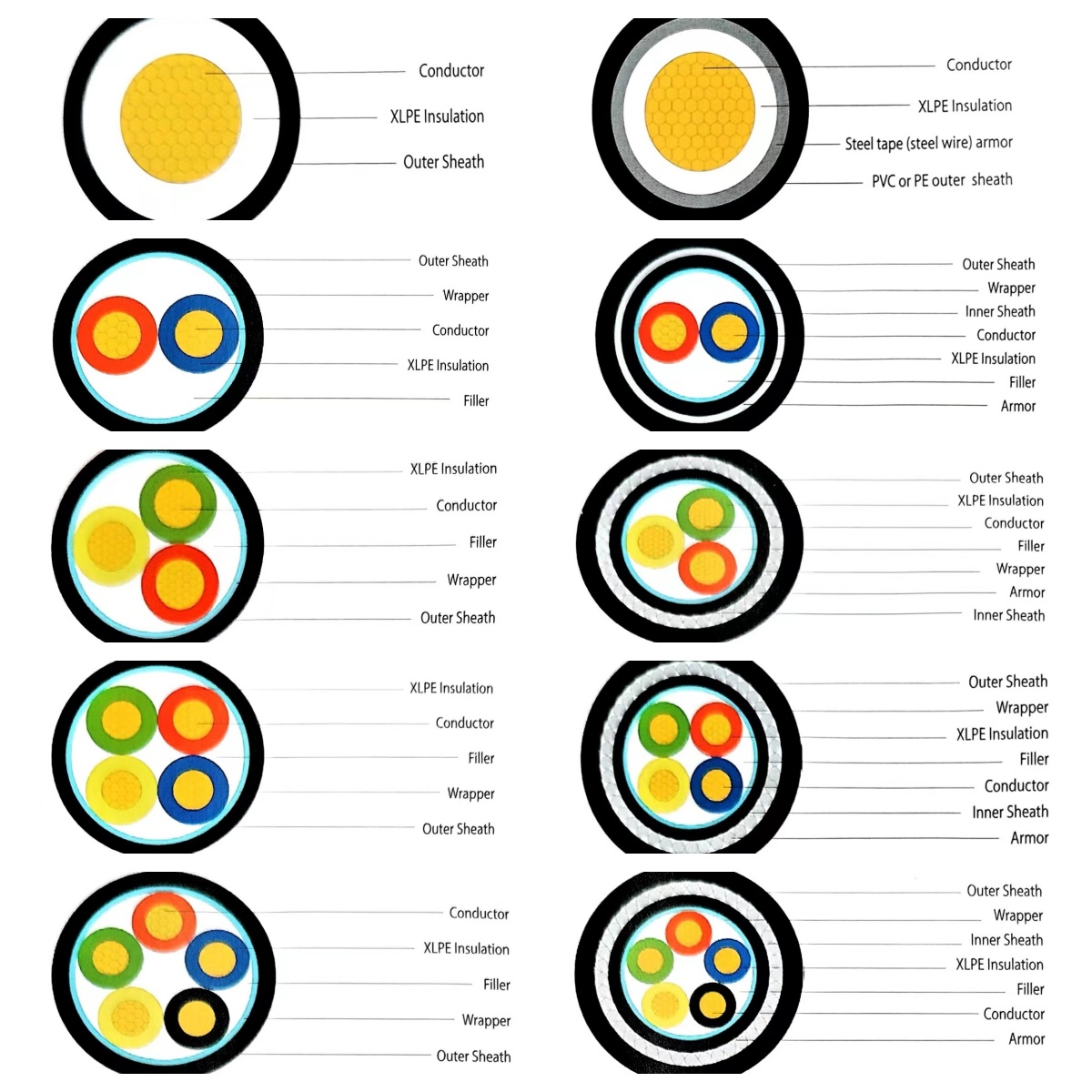
Conductor Material: This series of cables adopt conductor materials that meet the standards. High - purity copper is usually selected as the conductor. Copper has excellent electrical conductivity, which can effectively reduce the loss during power transmission and ensure the efficiency of power transmission. High - purity copper can also reduce the resistance of the conductor itself and improve the current - carrying capacity, which is an important basis for different specifications of this series of cables to meet different current - carrying requirements. At the same time, Copper Conductors have good ductility and mechanical strength, which can withstand a certain amount of external force during the production, laying and use of the cable, are not easy to break, and ensure the service life of the cable.
Insulating Material: The cable uses insulating materials that meet the standards, and the insulating layer has good electrical resistance. This kind of insulating material usually has high insulation resistance and breakdown strength, which can effectively prevent current leakage and ensure the insulation performance of the cable. Even in the long - term use process, it can resist the action of the electric field, is not easy to undergo insulation aging and damage, thus ensuring the safety of power transmission. In addition, the insulating material also has certain temperature resistance and corrosion resistance, and can adapt to the use requirements in different environments.
Style Design: The overall structure of this series of cables is suitable for fixed laying. In appearance, the cable presents a regular circular structure, which is convenient for arrangement and fixing during laying. The outer layer of the cable usually has a sheath. The sheath material has certain mechanical strength and wear resistance, which can protect the internal conductor and insulating layer from external damage. The fixed laying design enables the cable to maintain a stable position after installation, is not easy to be pulled and moved by external forces, thus ensuring the stability of power transmission.
Conductor Manufacturing: First, the copper raw materials are screened and purified to remove impurities to ensure that the purity of copper meets the requirements. Then, the copper material is drawn into Copper Wires with the required diameter through a wire drawing process, and multiple copper wires are stranded to form a conductor. The stranding process can improve the Flexibility and mechanical strength of the conductor, and at the same time ensure the uniform conductivity of the conductor. During the stranding process, the stranding pitch and tension are strictly controlled to ensure that the structure of the conductor is tight and stable.
Insulating Layer Extrusion: The extrusion molding process is used to wrap the insulating material around the outer layer of the conductor. Before extrusion, the insulating material is pretreated to ensure that it is in a good molten state. The molten insulating material is evenly wrapped around the surface of the conductor through an extruder to form an insulating layer. During the extrusion process, the extrusion temperature, speed and pressure are accurately controlled to ensure that the thickness of the insulating layer is uniform, the surface is smooth, and it is closely combined with the conductor without defects such as bubbles and impurities. The thickness of the insulating layer is designed according to the rated voltage and use scenario of the cable to ensure that it has good electrical resistance.
Cabling Process: Multiple conductors (main conductors and auxiliary conductors) wrapped with insulating layers are cabled according to a certain structure. During the cabling process, the conductors are stranded together by a cabling machine, and appropriate filling materials are filled at the same time to make the structure of the cable more round and stable. The filling material usually has certain elasticity and insulation performance, which can buffer the effect of external forces on the conductor and prevent moisture and impurities from entering the inside of the cable.
Sheath Extrusion: The sheath is extruded on the outer layer of the cabled cable. The sheath material is also strictly selected and has good mechanical properties, corrosion resistance and weather resistance. The extrusion process is similar to that of the insulating layer, ensuring that the sheath thickness is uniform, the surface is smooth, and it is closely combined with the internal structure. The sheath can further protect the internal structure of the cable and improve the overall strength and service life of the cable.
Quality Inspection: Strict quality inspection procedures are set in all links of production. The diameter, resistance and other parameters of the conductor are inspected; the thickness, electrical resistance, insulation resistance and other properties of the insulating layer are tested; the structure, outer diameter and other aspects of the cabled cable are checked; the thickness, mechanical properties and other characteristics of the sheath are inspected. Only the cables that pass all inspections can enter the next process, and finally ensure that the Rvfv series cables leaving the factory meet the relevant standards and requirements.
Transportation Methods: Select appropriate transportation methods according to factors such as the quantity, specification and transportation distance of the cables. For a small amount of short - distance transportation, truck transportation can be adopted; for a large amount of long - distance transportation, railway transportation or long - distance road transportation can be chosen. During transportation, it is necessary to ensure that the cable packaging is firm to avoid shaking and collision during transportation.
Transportation Precautions: Transport vehicles should drive smoothly, and avoid operations such as sudden braking and sharp turns to prevent the cable reels from rolling or colliding. Cables should avoid exposure to the sun, rain and high - temperature environments during transportation to prevent the insulating materials and sheath materials from being damaged by environmental factors. For reels with cables, they should be placed upright and not placed flat or stacked to avoid deformation of the reels due to pressure or damage to the cables due to extrusion. When loading and unloading cables, special loading and unloading equipment should be used, and rough loading and unloading is strictly prohibited to prevent the cable reels from falling or colliding.
Transportation Tracking: For long - distance transportation of cables, a transportation tracking system is established to monitor the position and driving status of transport vehicles in real - time. In case of special situations such as bad weather and road congestion, corresponding measures can be taken in time to ensure that the cables can be delivered to the destination on time and safely.
Delivery Preparation: After receiving the order, warehouse managers will accurately retrieve the Rvfv series cables of the corresponding specification and quantity according to the order requirements. Re - check the packaging and marking of the cables to ensure that they are consistent with the order information and that the packaging is intact. At the same time, prepare relevant delivery documents such as delivery notes, packing lists and quality inspection reports, and the information on the documents should be accurate and clear.
Delivery Process: Hand over the prepared cables and delivery documents to the transportation department. After the transportation department checks the cables and documents and confirms that they are correct, it arranges transport vehicles and personnel for delivery. Before delivery, the transport personnel will inspect the transport vehicles to ensure that the vehicles are in good condition and suitable for transporting cables. When delivering the goods, the delivery information will be fed back to the customer in time, informing the customer of the delivery time, transportation method, estimated arrival time and other information of the cable to facilitate the customer to make receiving preparations.
Emergency Delivery Service: Provide emergency delivery services for customers with urgent needs. After receiving an emergency order, give priority to arranging links such as goods retrieval, packaging and transportation to shorten the delivery time and ensure that the cables can be delivered to the customer as soon as possible.
Sample Provision: To facilitate customers to understand the quality and performance of Rvfv series cables, the company provides sample services. Customers can apply to the company for cable samples of the required specification according to their own needs. The specification of the samples is consistent with that of the actually sold products, which can truly reflect the characteristics of the products.
Sample Application Process: Customers can apply for samples through the company's official website, telephone, email and other methods, stating the specification, quantity of the required samples and their own contact information and other information. After receiving the application, the company will review it within a specified time, and arrange the preparation and delivery of samples after the review is passed.
Sample Fees and Refunds: For the sample fees, a certain fee is charged according to the specification and quantity of the samples, which can be refunded when the customer purchases the products in bulk later. The delivery fee of the samples is usually borne by the customer. The company will choose a suitable express company for delivery and inform the customer of the express waybill number in time to facilitate the customer to track the logistics information of the samples.
Sample Feedback: After the customer receives the samples, the company will take the initiative to contact the customer to learn about the customer's use experience and feedback on the samples. If the customer has any questions or suggestions about the samples, the company will answer and handle them in time to provide a reference for the customer's purchase decision.
Installation Guidance: Provide customers with guidance services on cable installation. After the customer receives the cable, if the customer needs it, the company will arrange professional technical personnel to explain the installation precautions, laying requirements, connection methods and other aspects of the cable to the customer through telephone, video or on - site guidance to ensure that the customer can install the cable correctly and ensure the use effect and safety of the cable.
Quality Assurance: The Rvfv series cables have undergone strict quality inspection before leaving the factory to ensure that the product quality meets relevant standards and requirements. The company provides a certain period of quality warranty for the products. During the warranty period, if the cable has quality problems caused by non - human factors, the company will provide free repair or replacement services for the customer.
Fault Handling: If the customer finds that the cable has a fault during use, they can contact the company's after - sales service department in time. After - sales service personnel will respond to the customer's demands at the first time, understand the fault situation, and provide corresponding solutions according to the cause of the fault. If on - site handling is needed, technical personnel will be arranged to arrive at the site for repair or replacement as soon as possible.
Customer Return Visit: Regularly conduct return visits to customers who use Rvfv series cables to learn about the use of the cables, customer satisfaction and the potential needs of customers. Through return visits, continuously improve product and service quality and improve customer loyalty. At the same time, collect customers' opinions and suggestions on the products to provide a basis for product upgrading and optimization.
Technical Support: Provide customers with long - term technical support services to answer various technical questions encountered by customers during the use of the cables. If customers need to re - select or adjust the cables during equipment upgrading, power distribution system transformation and other processes, the company's technical personnel will provide professional technical suggestions and solutions according to the actual needs of customers.


Công ty TNHH Công nghệ Cáp Hongtai
E-mail: export@qlcables.com
sales@qlcables.com
Tel/WhatsApp:+86-18032066271
Thêm khu vực phát triển công nghiệp Xiaokou, Hạt Ningjin, Thành phố Xingtai , tỉnh Hà Bắc, Trung Quốc
Bản quyền © Công ty TNHH Công nghệ Cáp Hongtai Hỗ trợ kỹ thuật:Công nghệ Ronglida
Trang web này sử dụng cookie để đảm bảo bạn có được trải nghiệm tốt nhất trên trang web của chúng tôi.
 English
 Español
 Portugues
 Pусский
 Français
 العربية
 ไทย
ไทย Türk dili
 Indonesia



 Điện thoại
 Thư
Thư