


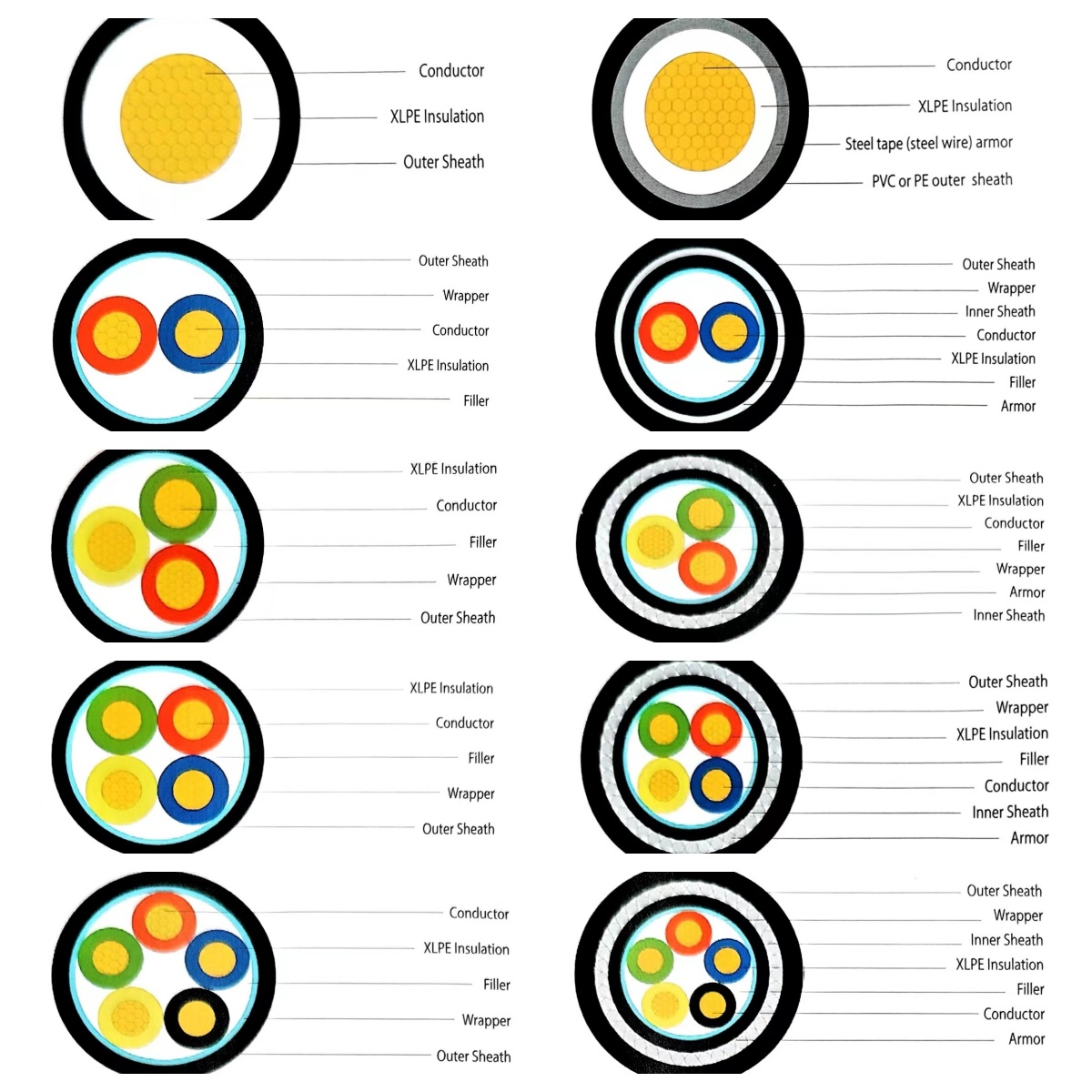
Conductor Material: The conductor of the cable is made of pure copper. Pure copper has an extremely high conductivity, reaching 100% IACS, which means that during power transmission, energy loss is extremely low, and power transmission efficiency can be improved. At the same time, pure copper has high mechanical strength and excellent bending resistance. During the transportation, laying and daily use of the cable, it is not easy to be damaged due to bending and collision. In addition, pure copper has good ductility, which is easy to be processed into the required conductor shape and size during production, ensuring the accuracy and consistency of the conductor.
Insulation Material: The insulation layer is made of PVC (polyvinyl chloride) material. The PVC insulation layer has stable chemical properties, with a temperature resistance range of -15℃ to 70℃, and can maintain good insulation performance at general ambient temperatures. It also has moisture-proof characteristics, which can prevent moisture from penetrating into the conductor, avoiding affecting the conductivity and causing safety problems. Moreover, PVC material is resistant to chemical corrosion and can be used normally in environments with slight chemical erosion. At the same time, the cost of PVC material is relatively low, which can reduce the overall cost of the cable on the premise of ensuring performance.
Style design: The cable has an overall circular structure, which has low resistance during laying and can reduce construction difficulty both in pipe laying and direct burial. The outer surface of the cable is smooth and flat, with clear marks such as specification model, rated voltage and manufacturer printed on it, which is convenient for users to identify and query relevant information. The 10mm² cable is relatively slender, and the 25mm² cable is slightly thicker, but both have certain Flexibility, which is convenient for laying and installation in complex environments.
Conductor manufacturing: First, high-quality pure copper raw materials are selected and smelted to remove impurities and improve the purity of copper. Then, the copper liquid is made into copper rods through a continuous casting process, and the diameter of the copper rods is controlled according to the specifications of the final conductor. Next, the copper rods are drawn through wire drawing dies to form Copper Wires with the required diameter. For the conductors of 4-Core Cables, a single copper wire is stranded. During the stranding process, the stranding pitch is strictly controlled to ensure that the conductor structure is tight and uniform, so as to ensure the stability of conductivity.
Insulation extrusion: The extrusion molding process is used to coat the PVC insulation layer on the outer layer of the conductor. The PVC material is heated to a molten state, and the molten PVC is evenly coated on the surface of the conductor through an extruder. During the extrusion process, parameters such as extrusion temperature and speed are accurately controlled to ensure that the insulation layer has uniform thickness, a smooth surface and no defects such as bubbles and impurities. After extrusion, the insulation layer is cooled and shaped to make it solidify quickly and ensure its stable performance.
Cabling process: 4 Conductors covered with insulation layers are subjected to cabling treatment. During cabling, 4 conductors are stranded together in a certain stranding direction and pitch to form a circular cable core. During the stranding process, in order to ensure the roundness and stability of the cable core, some suitable filling materials are filled between the conductors. The filling materials need to have certain elasticity and insulation performance to avoid mutual friction between conductors and damage to the insulation layer.
Sheath treatment: The outer layer of the cabled core is usually wrapped with a sheath, and the sheath material can also be PVC. The sheath material is evenly coated on the outer layer of the cable core through an extruder to ensure that the sheath has uniform thickness and is closely combined with the cable core. The sheath can further protect the cable core and enhance the mechanical strength and environmental resistance of the cable. After extrusion, the sheath is shaped through cooling, traction and other processes.
Testing process: Strict testing is carried out during production and after the finished product. It includes conductor resistance test to ensure that the conductivity of the conductor meets the standard; insulation resistance and withstand voltage test to inspect the insulation effect of the insulation layer; appearance inspection to check whether the surface of the cable is smooth, the marks are clear and there is any damage. Only cables that pass all testing items can leave the factory.
Transportation mode: Select an appropriate transportation mode according to the transportation distance and quantity. For short-distance transportation (within 300 kilometers), van trucks are generally used. Van trucks can provide good protection for cables to avoid sun exposure, rain and external collisions. For long-distance transportation, railway transportation or road freight 专线 can be chosen. Railway transportation has a large transportation capacity and good stability, which is suitable for long-distance transportation of large quantities of cables; road freight 专线 has high flexibility and can directly deliver goods to the designated place. For exported cables, sea freight or air freight can be used. Sea freight has a low cost but a long transportation time; air freight is fast and suitable for emergency orders.
Transportation precautions: During transportation, the cable should be avoided from severe collision, extrusion and vibration. When loading cables, the reels should be placed stably and fixed firmly to prevent rolling. Cables of different specifications should be loaded separately to avoid mutual extrusion. The transport vehicle should be kept clean to prevent the cable from being polluted by oil, chemical substances, etc. At the same time, the cable should be avoided from being exposed to the sun or rain for a long time to prevent aging of the insulation layer and sheath. During transportation in winter, attention should be paid to preventing the cable from freezing, especially in cold areas, appropriate thermal insulation measures can be taken.
Transportation tracking: Special personnel are arranged to track each batch of cable transportation. Through the logistics information system, the transport position, transport status and estimated arrival time of the goods are known in real time. If abnormal situations occur during transportation, such as traffic jams and vehicle failures, timely communication and coordination with the logistics company are carried out, and relevant information is fed back to customers to ensure that customers can know the dynamics of the goods in time.
Delivery process: After the customer places an order, the salesperson first confirms the order information, including the specification model, quantity, delivery address and delivery time of the cable. After confirmation, the order information is transmitted to the warehouse. Warehouse personnel prepare goods according to the order information, retrieve the corresponding cables from the inventory, and check the specifications, quantity and appearance of the cables to ensure they are consistent with the order. After checking, the cables are packaged according to the specified packaging method, and then the logistics department is notified to arrange transportation. The logistics department selects an appropriate transportation mode and vehicle according to the delivery information and goes through relevant transportation procedures. After delivery, the delivery order number, logistics company information, etc. are promptly notified to the customer to facilitate the customer's inquiry.
Delivery time: When the inventory is sufficient, cables of conventional specifications (10mm² and 25mm²) are generally delivered within 1-2 working days after receiving the order. If the customer has special requirements, such as customized length, the delivery time will be determined according to the production cycle. Usually, the delivery time will be communicated with the customer in advance, and the goods will be delivered on time within the agreed time. In case of delivery delay caused by force majeure, the customer will be notified as soon as possible with reasons, and solutions will be negotiated.
Delivery documents: Relevant documents are provided with the goods when delivering, including product certificate, inspection report, packing list, invoice, etc. The product certificate and inspection report prove that the quality of the cable meets relevant standards and requirements; the packing list details the specifications, quantity and packaging of the goods, which is convenient for the customer to check when receiving the goods; the invoice serves as the basis for the customer's payment and financial accounting. These documents will be properly packaged and sent together with the goods.
Sample provision: To enable customers to better understand the quality and performance of the products, the company provides sample services. Customers can apply for samples from salespersons through phone calls, emails, online platforms, etc., indicating the required specification and model of the samples. After receiving the application, the salesperson will confirm within 1 working day and arrange for sample preparation. The samples are generally 1-2 meters long cables, which can meet the customer's preliminary inspection needs for product appearance, specification, material, etc.
Sample cost: The samples themselves are provided to customers free of charge, but the transportation cost of the samples is borne by the customer. Customers can choose to pay the freight by cash on delivery or pay the freight to the company in advance. For large customers with clear purchase intentions, they can apply for a reduction or exemption of the sample transportation cost. The specific situation can be negotiated with the salesperson.
Sample feedback: After receiving the samples, if customers have any questions or suggestions, they can contact the salesperson at any time. The company will arrange professionals to answer customers' questions and carefully record customers' feedback. If the customer is satisfied with the sample and confirms the purchase intention, the salesperson will follow up in a timely manner to provide the customer with a detailed product quotation and purchase plan.
Quality assurance: The company provides quality assurance for the 4-core power cable, and the product warranty period is 18 months from the date the customer receives the goods. During the warranty period, if the product cannot be used normally due to its own quality problems (such as damage caused by non-human factors such as insulation layer cracking and conductor breaking), the customer can apply for after-sales treatment to the company with the purchase certificate and product certificate. The company will provide customers with free repair or replacement services according to the actual situation.
After - sales consultation: If customers encounter any problems during product use, such as installation methods and performance parameters, they can consult through the company's after-sales service phone, online customer service, email and other channels. After-sales service personnel will respond to customers' consultations within 24 hours and provide professional and accurate answers and suggestions.
Fault handling: If the cable fails during use, the customer can report the fault to the company's after-sales department. After-sales personnel will first understand the fault situation and make a preliminary judgment through phone calls or online communication. For simple faults, guide customers to handle them by themselves; for complex faults or those requiring on-site maintenance, the company will arrange professional and technical personnel to arrive at the site for inspection and maintenance within the agreed time.
Return and exchange service: If the customer finds that the product has problems such as wrong specification model and appearance damage after receiving the cable, and it is not caused by the customer themselves, they can apply for return or exchange within 7 days after receiving the goods. The customer needs to provide relevant photos and other evidence. After verification by the company, the return or exchange will be arranged, and the transportation cost incurred during the return or exchange will be borne by the company.
Regular return visits: The company will conduct regular return visits to customers who have purchased cables. The return visit methods include telephone return visits and questionnaires. The return visit content mainly includes understanding the product use situation, customer satisfaction and whether there are new needs. Through return visits, problems encountered by customers during use can be found and solved in a timely manner, and product and service quality can be continuously improved.


Công ty TNHH Công nghệ Cáp Hongtai
E-mail: export@qlcables.com
sales@qlcables.com
Tel/WhatsApp:+86-18032066271
Thêm khu vực phát triển công nghiệp Xiaokou, Hạt Ningjin, Thành phố Xingtai , tỉnh Hà Bắc, Trung Quốc
Bản quyền © Công ty TNHH Công nghệ Cáp Hongtai Hỗ trợ kỹ thuật:Công nghệ Ronglida
Trang web này sử dụng cookie để đảm bảo bạn có được trải nghiệm tốt nhất trên trang web của chúng tôi.
 English
 Español
 Portugues
 Pусский
 Français
 العربية
 ไทย
ไทย Türk dili
 Indonesia



 Điện thoại
 Thư
Thư