Detailed Introduction to U1000 Rvfv XLPE Power Cable 4G 16mm²
I. From the Perspective of the Product Itself
(1) Specification Parameters
The U1000 Rvfv
XLPE Power Cable 4G 16mm² has precise and strict settings in terms of specification parameters. Each parameter has been carefully designed and tested to ensure its stable and efficient operation in medium and high-voltage power distribution systems.
The cable is designed with
4 Cores, each with a conductor cross-sectional area of 16mm². This specification enables the cable to meet the demand for large current transmission under a working voltage of 1000V and above. Among the 4-core structure, 3 cores are phase wires and
1 Core is a grounding core. This design not only complies with electrical safety regulations but also reduces the skin effect through
Multi-Core current shunting, thereby lowering energy loss during transmission.
Conductor DC resistance is an important indicator to measure the conductivity of the cable. At 20°C, the conductor DC resistance of this cable is ≤1.15Ω/km. This extremely low resistance value ensures minimal loss of electrical energy during transmission, with an electrical energy conversion efficiency of over 95%, which can provide stable power supply for electrical equipment, especially suitable for places sensitive to energy consumption.
The insulation layer is made of cross-linked polyethylene (XLPE) material, with an insulation resistance of ≥1000MΩ·km. Compared with traditional PVC
Insulation Materials, the insulation resistance has increased by more than 30%. High insulation resistance ensures good insulation performance of the cable, which can effectively block current leakage and prevent faults such as short circuits. In the power frequency withstand voltage test, the cable can withstand 10kV voltage for 5 minutes without breakdown, fully demonstrating its excellent voltage withstand capacity, enabling it to work safely and reliably in medium and high-voltage environments.
The cable has a wide temperature resistance range and can operate stably for a long time in an environment of -40°C to 90°C. This feature allows it to adapt to the climatic conditions of different regions, whether in the cold north or the hot south, whether in outdoor environments with alternating high and low temperatures or indoor places with relatively stable temperatures, it can function normally.
The impact strength of the sheath reaches 12kJ/m², which can withstand mechanical actions such as dragging and extrusion during construction, providing effective protection for the internal insulation layer and conductor. In terms of flame retardancy, the cable achieves the GB/T 18380.3-2008 Class B flame retardant grade through a halogen inhibition formula. In case of fire, the smoke density is ≤75%, and the release of toxic gases is 50% lower than the industry standard, greatly improving safety in fire situations.
The bending radius of the cable is ≥12 times the outer diameter. This good
Flexibility allows the cable to adapt to various complex wiring environments during installation, facilitating pipe wiring in walls and ceilings, and improving the convenience and efficiency of construction.
In addition, the cable has passed the EU CE certification and domestic CCC certification. Each meter of the sheath is printed with clear marks, including model, cross-section, standard number and other information. These marks not only facilitate users to identify and trace the product but also prove that the product meets relevant quality and safety standards.
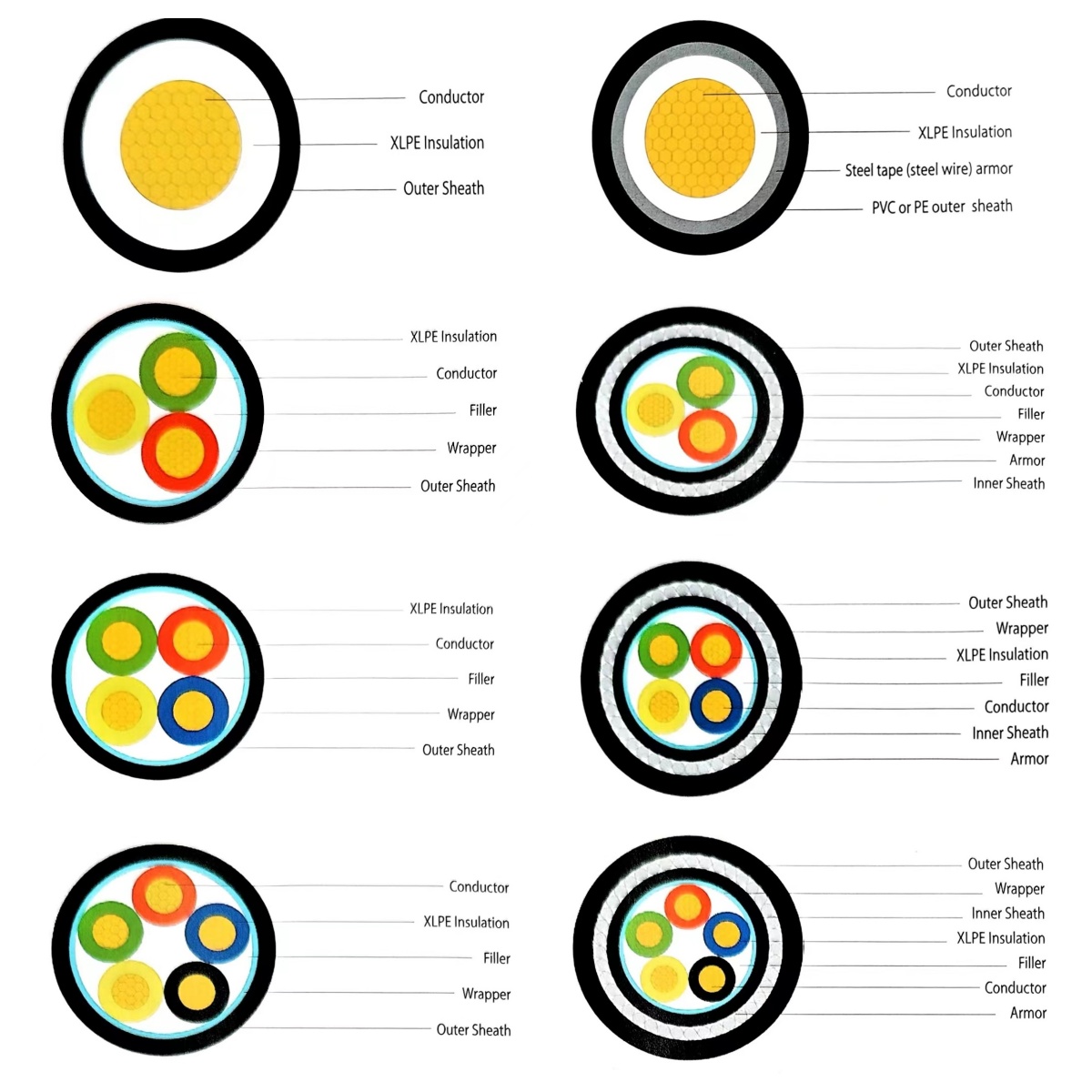
(2) Characteristic Uses
The U1000 Rvfv XLPE Power Cable 4G 16mm², with its excellent performance and reasonable structural design, has a wide range of characteristic uses in multiple fields and can meet power transmission needs in different scenarios.
In the industrial field, this cable is an ideal choice for power transmission of assembly line motors, frequency conversion equipment, etc. In industrial production, assembly line motors and frequency conversion equipment have large power demand and require stability. The 4-core 16mm² specification of this cable can provide sufficient current to ensure the normal operation of the equipment. At the same time, the grounding core in the 4-core structure can conduct leakage current in real time, meeting the EN 60228 safety specification and providing guarantee for the safety of industrial production. For example, in the welding assembly line of an automobile manufacturing plant, a large number of welding robots need stable power supply. This cable can withstand the instantaneous large current when the robot is working, and the grounding core can timely conduct the possible leakage current, avoiding safety accidents caused by electric leakage.
In construction engineering, this cable plays an important role in the building power distribution system. With the development of smart buildings, the requirements for the reliability and flexibility of power supply are getting higher and higher. The flexibility of this cable (bending radius ≥12 times the outer diameter) makes it easy to wire in pipes in walls and ceilings, and can support multi-loop power supply in smart buildings. In commercial complexes, various electrical equipment such as air conditioners, elevators, and lighting are densely distributed. This cable can provide stable power for these equipment, and its flame retardant performance can reduce the release of smoke and toxic gases in case of fire, buying time for personnel evacuation and fire rescue. In places such as hospitals, the requirements for the safety and stability of electricity are extremely high. The high insulation performance and reliable grounding design of this cable can ensure the normal operation of medical equipment and protect the lives of patients.
New energy facilities are also an important application field of this cable. In photovoltaic
Power Stations, the electricity generated by photovoltaic panel arrays needs to be transmitted to inverters and combiner boxes through cables. This cable can withstand the high-temperature radiation of photovoltaic panel arrays in the sun and maintain stable performance in high-temperature environments. At the same time, its good insulation performance can resist the influence of outdoor environmental factors such as moisture and dust, ensuring efficient transmission of electrical energy. In wind farms, the environment inside the wind turbine tower is special, with vibrations and other conditions. The impact strength of this cable reaches 12kJ/m², which can withstand the mechanical stress caused by vibration, making it an ideal connection carrier between the inverter and the combiner box, ensuring the smooth progress of wind power generation.
Data centers have extremely high requirements for the stability and energy consumption of electricity. The low transmission loss characteristic (electrical energy conversion efficiency over 95%) of the U1000 Rvfv XLPE Power Cable 4G 16mm² makes it the preferred choice for data center power distribution systems. A large number of servers, switches and other equipment in data centers need continuous and stable power supply. This cable can provide reliable power support for these equipment, reducing equipment failures and data loss caused by power problems.
In addition, this cable is also suitable for power distribution systems of large public facilities such as subways and airports. These places are crowded with people and have many electrical equipment, and have strict requirements for the safety, reliability and flame retardancy of cables. This cable can meet these requirements and provide power guarantee for the normal operation of public facilities.
(3) Material and Style
The U1000 Rvfv XLPE Power Cable 4G 16mm² fully considers performance, safety and usage needs in material selection and style design to ensure that the product can perform well in various complex environments.
In terms of materials, the conductor is made of high-purity electrolytic copper with a purity of more than 99.95%. High-purity copper has excellent conductivity, which can reduce the resistance during current transmission, reduce energy loss, and improve the efficiency of electrical energy transmission. At the same time, electrolytic copper has good ductility and plasticity, and can withstand mechanical actions such as bending and stretching during cable production and laying without breaking, ensuring the service life of the cable. In addition, copper has good thermal conductivity, which can timely dissipate the heat generated by the cable during operation, avoiding the impact on the cable's performance due to overheating.
The insulation layer is made of cross-linked polyethylene (XLPE) material, which forms a three-dimensional network molecular structure after special cross-linking treatment. Compared with traditional polyethylene materials, its mechanical strength, temperature resistance and aging resistance have been significantly improved. The temperature resistance range of XLPE material is extended to -40°C to 90°C, which can work stably for a long time in environments with alternating high and low temperatures, and will not cause the insulation performance to decline due to temperature changes. At the same time, it has high insulation resistance and good chemical corrosion resistance, which can effectively resist the erosion of moisture, dust and chemical substances, ensuring the long-term stability of the cable's insulation performance.
The sheath of the RVFV model is made of flame-retardant polyvinyl chloride (PVC) material, which has dual protection functions. On the one hand, it forms a mechanical barrier by tightly covering the insulation layer, with an impact strength of 12kJ/m², which can withstand mechanical actions such as dragging and extrusion during construction, and protect the internal insulation layer and conductor from damage. On the other hand, by adding a halogen inhibition formula, the sheath reaches the GB/T 18380.3-2008 Class B flame retardant grade. In case of fire, it can delay the spread of flames, reduce the generation of smoke and the release of toxic gases, and create favorable conditions for personnel evacuation and fire rescue.
In terms of style design, the cable adopts a 4-core stranded structure, which makes the cable have good flexibility, with a bending radius ≥12 times the outer diameter, facilitating installation and laying in various complex wiring environments. The
4 Cores are 3 phase wires and 1 grounding core respectively, with clear color distinction. The phase wires usually adopt yellow, green and red colors, and the grounding core adopts yellow-green 双色. This color identification is convenient for construction personnel to accurately identify during installation, avoiding wiring errors, and improving construction efficiency and safety.
The appearance of the cable is black, which is due to the flame-retardant PVC material used for the sheath. The black appearance is not only beautiful and generous but also has certain light resistance, which can reduce the aging effect of direct sunlight on the cable. On the surface of the sheath, each meter is printed with clear marks, including model, cross-section, standard number, manufacturer and other information. These marks not only facilitate users to identify and trace the product but also reflect the standardized production of the product.
In addition, the structure of the cable is compact, and the materials of each layer are firmly bonded, which can prevent moisture, dust and other impurities from entering the cable, ensuring that the performance of the cable is not affected. At the same time, the weight of the cable is reasonably designed, which not only ensures the strength and performance of the product but also facilitates transportation and installation.
(4) Production Process
The production process of U1000 Rvfv XLPE Power Cable 4G 16mm² is advanced and rigorous. Each process is strictly controlled and inspected to ensure that the quality and performance of the product meet the design standards.
The first is the manufacturing process of the conductor. High-purity electrolytic copper rods are selected as raw materials, and the copper rods are drawn into
Copper Wires with the required diameter through a wire drawing machine. During the wire drawing process, it is necessary to accurately control the drawing speed, die size and cooling method to ensure that the diameter of the copper wire is uniform, the surface is smooth, and defects such as burrs and scratches are avoided. The drawn copper wire needs to be annealed. The copper wire is heated to a certain temperature (usually 300°C ~ 500°C) and kept warm for a period of time, then slowly cooled to eliminate internal stress in the copper wire and improve its flexibility and conductivity. The annealed copper wires are stranded through a bunching machine to form a 16mm² single-core conductor. During the stranding process, the stranding pitch and tension must be strictly controlled to ensure that the structure of the conductor is tight and round, reducing the skin effect during current transmission and improving the conductivity efficiency.
Next is the extrusion and cross-linking process of the insulation layer. Cross-linked polyethylene (XLPE) material is used as the insulation layer. First, the XLPE particles are pretreated to remove moisture and impurities to ensure the quality of the insulation layer. Then, the pretreated XLPE material is evenly coated on the surface of the conductor through an extruder to form an insulation layer. During the extrusion process, it is necessary to accurately control the extrusion temperature, pressure and speed to ensure that the insulation layer has uniform thickness, smooth surface, and is tightly bonded to the conductor. The extruded
Insulated Wire core needs to be cross-linked. The commonly used cross-linking methods are dry cross-linking and warm water cross-linking. Dry cross-linking is to put the insulated wire core into a cross-linking tube and carry out cross-linking reaction in a high-temperature and high-pressure nitrogen environment; warm water cross-linking is to soak the insulated wire core in warm water and initiate cross-linking reaction through water as a medium. After cross-linking treatment, XLPE molecules form a three-dimensional network structure, which significantly improves the temperature resistance, mechanical strength and insulation performance of the insulation layer.
Then there is the cabling process. The 4 insulated wire cores (3 phase wires and 1 grounding core) are stranded into a cable according to a certain stranding direction and pitch. In the cabling process, in order to ensure the roundness and stability of the cable, it is necessary to fill appropriate filling materials, such as polypropylene rope, between the insulated wire cores. The filling material should have good flexibility and corrosion resistance, which can buffer the interaction between the wire cores and reduce wear during laying. After cabling, a layer of non-woven fabric or polyester tape is wrapped around the cable to play the role of binding and isolation, preventing the wire cores from loosening and the sheath material from seeping into the wire cores.
Finally, the extrusion process of the sheath is carried out. Flame-retardant polyvinyl chloride (PVC) material is used as the sheath. PVC particles are mixed with flame retardants, stabilizers and other additives in a certain proportion, and then the mixture is evenly coated on the outside of the cabled cable core through an extruder to form a sheath. During the extrusion process, it is necessary to control the extrusion temperature, pressure and speed to ensure that the sheath has uniform thickness, smooth surface, and is tightly bonded to the cable core. The thickness of the sheath should meet the design requirements to ensure that it can provide effective mechanical protection and flame retardant performance for the cable. After extrusion, the cable is cooled to make it solidify quickly.
During the entire production process, multiple quality inspection procedures are required. After the conductor is manufactured, its diameter, DC resistance and other parameters are tested to ensure compliance with standards; after the insulation layer is extruded and cross-linked, its thickness, insulation resistance, voltage withstand performance, etc., are tested; after cabling, the structural size and roundness of the cable are tested; after the sheath is extruded, its thickness, appearance, flame retardant performance, impact strength, etc., are tested. In addition, the finished cable also needs to undergo overall performance tests such as power frequency withstand voltage test, partial discharge test, and aging test. Only products that meet the requirements in all indicators can leave the factory.
Advanced automatic control technology and online monitoring equipment are adopted in the production process to monitor and adjust various parameters in the production process in real time, ensuring the stability and consistency of the production process. At the same time, the environment of the production workshop is strictly controlled to keep it clean, dry and constant temperature, avoiding the impact of dust, humidity and other factors on product quality.
II. From the Perspective of General Product Information
(1) Packaging
The packaging design of U1000 Rvfv XLPE Power Cable 4G 16mm² fully considers the product's protection, transportation and storage needs, and adopts a scientific and reasonable packaging method to ensure that the cable remains in good quality before reaching the user.
The cable is usually packaged with cable reels, which are available in wooden and steel types. For short-distance transportation, small-batch shipments or indoor storage, wooden cable reels are a more economical choice. Wooden cable reels are relatively light in weight, relatively low in cost, and easy to manually carry and load/unload. However, the strength of wooden cable reels is relatively low, and their impact resistance is poor, so they are not suitable for long-distance transportation or storage in harsh environments.
Steel cable reels have high strength, high load-bearing capacity and good impact resistance, and are suitable for long-distance transportation, large-batch shipments and outdoor storage. Steel cable reels can withstand the weight of the cable and various external impacts during transportation, effectively protecting the cable from damage. The surface of steel cable reels is usually subjected to anti-corrosion treatment, such as painting and galvanizing, to prevent rust during transportation and storage and extend their service life.
When the cable is wound onto the cable reel, it needs to be done according to a certain tension and order to ensure that the cable is arranged neatly and tightly, avoiding looseness, distortion or mutual friction. During the winding process, the winding speed must be controlled to avoid excessive stretching or extrusion of the cable due to too fast speed, which will affect the performance of the cable. After winding, sealed 封头 are installed at both ends of the cable to prevent moisture, dust and other impurities from entering the cable.
To further protect the cable, a layer of plastic film is wrapped around the outside of the cable reel. The plastic film has good moisture-proof and dust-proof properties, which can prevent the cable from getting damp and contaminated with dust during transportation and storage. For cables that need to be stored for a long time, a layer of linen or canvas can be wrapped around the outside of the plastic film. Linen or canvas has certain air permeability and wear resistance, which can protect the cable reel from collision and friction, and also play a role in sun protection and ultraviolet protection, delaying the aging of the cable sheath.
The cable reel will be clearly marked with relevant product information, including product name, model specification (U1000 Rvfv XLPE Power Cable 4G 16mm²), length, weight, manufacturer, production date, implementation standard, certification mark, etc. This information is convenient for users to check and identify when receiving and accepting products, and is also conducive to product traceability and management. Lifting holes are also installed on the side of the cable reel to facilitate lifting and handling with cranes and other equipment.
For exported cables, the packaging also needs to meet international transportation standards and the import requirements of relevant countries. For example, wooden cable reels need to be fumigated to prevent the spread of diseases and pests; the marks on the packaging need to be in English or the language of the destination country to ensure clear understanding by foreign customers. Additionally, export packaging must comply with customs inspection requirements and facilitate loading/unloading operations at ports.
(2) Transportation
Transportation of the U1000 Rvfv XLPE Power Cable 4G 16mm² requires strict adherence to logistics regulations to ensure timely and damage-free delivery. The choice of transportation mode depends on factors such as distance, quantity, and urgency.
Road transportation is preferred for short to medium distances and small to medium batches. Specialized trucks with flatbeds or enclosed trailers are used to accommodate cable reels. During loading, reels are secured with steel straps or chains to prevent shifting during transit. Drivers are instructed to avoid rough terrain and sudden maneuvers to minimize vibration, which could loosen windings or damage the sheath. For urban deliveries, route planning accounts for height restrictions and traffic restrictions to ensure on-time arrival.
Rail transportation is suitable for large-volume, long-distance shipments. Cable reels are loaded into freight cars using forklifts or cranes, with wooden spacers placed between reels to prevent abrasion. Rail operators provide tracking services to monitor shipment progress, and climate-controlled containers are used for sensitive routes to protect against extreme temperatures.
Maritime transportation serves international markets, with cable reels loaded into shipping containers. Waterproof covers are applied to prevent saltwater corrosion, and reels are secured with dunnage to withstand oceanic vibrations. Shipping documents, including bills of lading and material safety data sheets, accompany each shipment to facilitate customs clearance. Transit times are coordinated with customers to align with project timelines.
Air freight is reserved for urgent orders, though limited by weight restrictions. Smaller cable lengths are packaged in reinforced crates with shock-absorbing foam. Airlines classify the cables as non-hazardous goods, but proper labeling ensures compliance with IATA regulations.
Throughout all transportation modes, temperature monitoring devices may be attached to reels for shipments in extreme climates, alerting logistics teams to potential heat or cold damage. Upon arrival, recipients inspect reels for signs of mishandling, such as bent flanges or torn packaging, before signing delivery receipts.
(3) Shipping and Delivery
The shipping process begins with order confirmation, where sales teams verify specifications, quantities, and delivery addresses. For in-stock items, warehouse staff retrieve cables using barcode scanners to ensure accuracy. Each reel undergoes pre-shipment inspection: checking for intact seals, unbroken windings, and legible markings.
Custom-length orders trigger production scheduling, with manufacturing teams prioritizing urgent requests. Quality control technicians perform final tests on finished cables, including insulation resistance checks and visual inspections, before releasing them for shipping.
Once ready, logistics coordinators book transportation and generate shipping documents. Commercial invoices detail product specifications, quantities, and values for customs purposes, while packing lists itemize contents of each reel. Tracking numbers are shared with customers via email or SMS, allowing real-time monitoring through the logistics provider’s portal.
Delivery coordination includes pre-arranged time slots to ensure recipient availability. For large installations, technical staff may accompany deliveries to assist with unloading using on-site cranes. Upon delivery, customers sign proof-of-delivery documents, noting any discrepancies such as damaged packaging or incorrect lengths. These documents are archived for quality 追溯.
International shipments require additional steps: obtaining export licenses, preparing certificates of origin, and complying with destination country regulations (e.g., RoHS compliance for European markets). Freight forwarders manage customs brokerage, ensuring timely clearance to avoid port storage fees.
(4) Samples and After-Sales Service
To facilitate customer evaluation, the company provides sample cables of 1-5 meters in length. Sample requests are processed within 48 hours, with specimens cut from production runs to ensure representativeness. Each sample includes a test report detailing conductor resistance, insulation thickness, and flame retardancy results. Samples are shipped via express courier in protective tubes, with tracking information provided to customers.
After-sales service begins with installation guidance: technical engineers offer on-site support to ensure proper handling, such as maintaining minimum bending radii during 敷设. Installation manuals include diagrams for termination procedures and torque specifications for cable lugs.
Warranty coverage spans 10 years from the delivery date, covering manufacturing defects such as insulation breakdown or conductor flaws. Claims are processed by submitting photos and test reports, with replacement cables shipped within 72 hours of approval. For critical failures, technical teams conduct root-cause analyses to prevent recurrence.
The company maintains a 24/7 customer service hotline for troubleshooting. Common issues like sheath abrasions can be resolved with repair kits containing heat-shrink sleeves and adhesive tapes. For complex problems, remote diagnostics via video calls help identify issues before dispatching field technicians.
Regular maintenance reminders are sent to customers, recommending periodic insulation resistance testing and visual inspections for signs of aging. The company also offers cable recycling services at the end of service life, ensuring compliance with environmental regulations such as WEEE directives in Europe.


 English
 Español
 Portugues
 Pусский
 Français
 العربية
 ไทย
ไทย Türk dili
 Indonesia



 Điện thoại
 Thư
Thư