Detailed Introduction to Dual-Core Aluminum Power Cables (2x10, 2x16, 2x25, 2x35 mm², 600/1000V)
I. From the Perspective of the Product Itself
(I) Specification Parameters
The specification parameters of dual-core aluminum
Power Cables are carefully designed to meet low-voltage power transmission needs in different scenarios, with each parameter having clear standards and practical application value.
This series of cables adopts a dual-core parallel structure, with single-core cross-sectional areas of 10mm², 16mm², 25mm², and 35mm² respectively. This gradient cross-sectional area design enables the cables to adapt to different current-carrying requirements. The 2x10mm² cable, when laid in the air with good heat dissipation conditions, has a current-carrying capacity of approximately 55-65A; when laid underground with relatively poor heat dissipation, the current-carrying capacity is about 45-55A. The 2x16mm² cable has an air current-carrying capacity of 70-80A and an underground current-carrying capacity of 55-65A. Compared with the 2x10mm² cable, it can carry a larger current and is suitable for equipment with slightly higher power. The 2x25mm² cable has an air current-carrying capacity of 90-105A and an underground current-carrying capacity of 75-85A, further enhancing the current-carrying capacity and can be used to connect electrical equipment with larger power. The 2x35mm² cable has an air current-carrying capacity of 110-130A and an underground current-carrying capacity of 90-105A, which is the largest current-carrying specification in this series and can meet the needs of larger capacity power transmission.
The rated voltage is 600/1000V, which complies with international low-voltage distribution standards and can be directly connected to industrial and civil low-voltage power grids. Whether it is motors, distribution boxes, lighting systems, or other types of electrical equipment, they can be well adapted to this cable, ensuring the stability and safety of power transmission.
The outer diameter of the cable also increases accordingly with the increase of the cross-sectional area. The outer diameter of the 2x10mm² cable is approximately 12-15mm, the 2x16mm² cable is about 14-17mm, the 2x25mm² cable is around 16-19mm, and the 2x35mm² cable is about 18-21mm. The reasonable design of the outer diameter not only ensures the stability of the internal structure of the cable but also can adapt to different laying environments, such as pipe threading and direct burial.
The bending radius is not less than 10 times the outer diameter. This parameter ensures that the cable can be flexibly laid in narrow spaces, meeting the needs of complex environments such as pipe penetration in building walls and wiring around equipment. During installation, even if a certain degree of bending is required, it will not affect the performance of the cable.
In addition, the insulation resistance of the cable is ≥500MΩ·km, and it has passed the power frequency withstand voltage test (3kV/5min without breakdown). These parameters ensure the insulation performance of the cable and can effectively prevent safety accidents such as electric leakage.
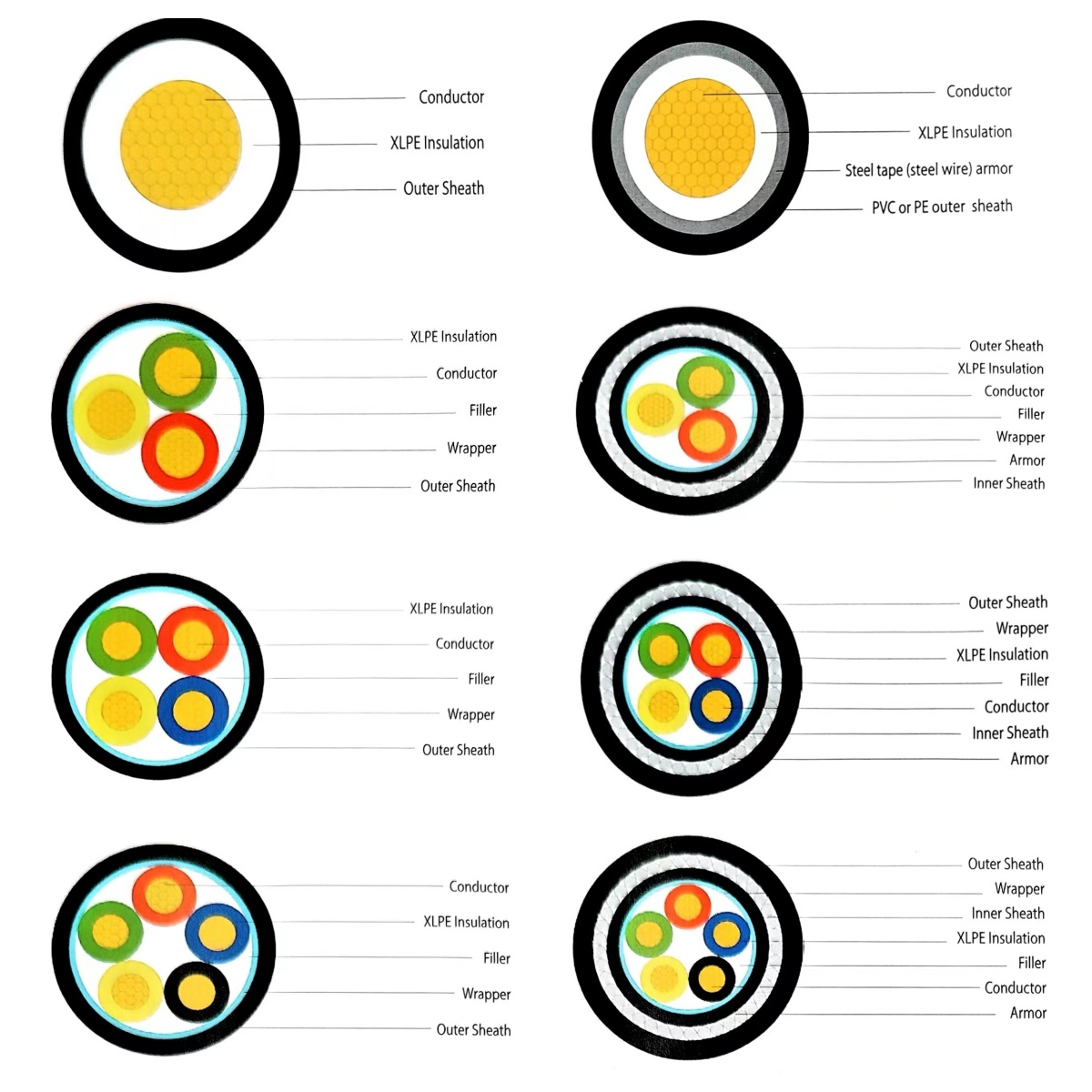
(II) Characteristic Applications
Dual-core
Aluminum Power Cables, with their unique design and performance, are widely used in many fields, providing reliable solutions for power transmission in different scenarios.
In the field of civil construction, 2x10mm² and 2x16mm² cables play an important role. They are often used for branch lines from household distribution boxes to various rooms, distributing power from the main distribution box to sockets and lamps in each room to ensure the normal supply of household electricity. At the same time, these two specifications of cables are also suitable for power connection of lighting, air conditioners, and other household appliances. For lighting systems, their power is relatively small, and 2x10mm² cables are sufficient to meet the demand; for household appliances with slightly higher power such as air conditioners, 2x16mm² cables can be chosen to ensure stable operation.
In the industrial field, 2x25mm² and 2x35mm² cables are widely used. They can be used as
Power Lines for small and medium-sized motors, water pumps, and other equipment, providing stable power support for these equipment. In temporary power supply lines in workshops, these two specifications of cables can also play an important role, meeting the electricity demand during temporary construction or equipment debugging. Since industrial equipment usually has large power, it has high requirements for the current-carrying capacity of cables. The current-carrying capacity of 2x25mm² and 2x35mm² cables can well adapt to these equipment.
In outdoor scenarios, models with XLPE insulation perform well. Garden lighting requires cables to have good weather resistance to cope with natural factors such as outdoor wind, rain, and ultraviolet rays. The ultraviolet resistance and rain resistance of the XLPE insulation layer can ensure the long-term stable operation of the cable. Small outdoor distribution box connections also often use this kind of cable to transmit power from the main power grid to the outdoor distribution box, and then distribute it to various outdoor electrical equipment.
The dual-core design is a major feature of this series of cables, which simplifies the wiring process, especially suitable for scenarios where live wires and neutral wires need to be transmitted in parallel. In traditional wiring, live wires and neutral wires need to be laid separately, which not only increases the construction difficulty but also may cause line confusion. The dual-
Core Cable integrates the live wire and neutral wire, making wiring more convenient and neat, and reducing the probability of failures.
In addition, the cable has good bending performance, with a bending radius not less than 10 times the outer diameter, which is convenient for laying in narrow spaces. When 穿管 in building walls, the cable needs to be able to bend flexibly to pass through the pipeline; when wiring around equipment, it often needs to bypass various parts of the equipment. The good bending performance of the cable can meet the needs of these complex environments.
(III) Material and Style
Material
The conductor is made of high-purity aluminum rod with a purity of ≥99.5%. High-purity aluminum can ensure good conductivity. Although its conductivity is slightly lower than that of copper (about 60% of copper), it can meet basic conductivity requirements in low-voltage power transmission scenarios. At the same time, aluminum is rich in resources and relatively low in price, which significantly reduces the cost of the cable and has high economy.
The surface of the
Aluminum Conductor is subjected to anti-oxidation treatment, which can effectively delay the corrosion rate of aluminum. Aluminum is easy to oxidize in the air to form an oxide film, but this oxide film is relatively loose and cannot effectively prevent further corrosion. Through anti-oxidation treatment, a dense oxide film can be formed to protect the aluminum conductor from corrosion and extend the service life of the cable.
The insulation layer mainly has two materials: PVC and XLPE. The
PVC Insulation layer has a temperature resistance range of -15℃ to 70℃, suitable for dry indoor environments. PVC materials have good insulation performance and processing performance, and the price is relatively low, making them commonly used
Insulation Materials in indoor scenarios. The XLPE insulation layer has a temperature resistance of -40℃ to 90℃, with better anti-aging and weather resistance, and can be used in outdoor or humid environments. XLPE materials form a three-dimensional network structure through cross-linking reaction, which makes them have better thermal stability, mechanical strength, and chemical corrosion resistance, and can adapt to more harsh environments.
The sheath layer is mostly made of PVC material, mainly black in color. The
PVC Sheath has good mechanical properties and can protect the internal conductor and insulation layer of the cable from external physical damage. The black sheath has good ultraviolet resistance, which can reduce the aging effect of direct sunlight on the sheath. The surface of the sheath is printed with clear specification marks and certification information (such as CE, ROHS). These marks are convenient for users to identify the specifications and quality of the cable, and also indicate that the cable meets relevant international standards and environmental protection requirements.
Some models can be customized with flame-retardant sheaths to meet the use in places with high fire protection requirements. In case of fire, the flame-retardant sheath can delay the spread of flame, reduce the generation of smoke, gain time for personnel evacuation and fire fighting and rescue, and improve the safety of the place.
Style
In terms of appearance, the dual-core aluminum power cable adopts a parallel dual-core structure, with two core wires arranged side by side, closely combined through the insulation layer and sheath layer. This structure makes the laying of the cable more convenient and also ensures the relative stability between the two core wires.
The color of the cable is mainly determined by the sheath layer, mainly black. Black not only has good ultraviolet resistance but also can blend with various environments without affecting the appearance. In some special scenarios, sheaths of other colors can also be customized according to user needs, but black is the most common style.
According to different insulation materials, cables can be divided into two styles: PVC insulation and XLPE insulation. The PVC insulation style is suitable for dry indoor environments and is more affordable; the XLPE insulation style is suitable for outdoor or humid environments, with more excellent performance but relatively higher price. Users can choose the appropriate style according to specific use scenarios.
In addition, according to whether it has flame-retardant performance, it can also be divided into two styles: ordinary sheath and flame-retardant sheath. The ordinary sheath is suitable for general places, and the flame-retardant sheath is suitable for places with high fire protection requirements, such as shopping malls, hospitals, office buildings, etc.
(IV) Production Process
The production process of dual-core
Aluminum Power Cables is rigorous and meticulous, and each link needs to be strictly controlled to ensure the quality and performance of the product.
Aluminum Conductor Manufacturing
First, high-purity aluminum rods (purity ≥99.5%) are selected as raw materials. The aluminum rod is put into a wire drawing machine for wire drawing treatment, and the aluminum rod is drawn into
Aluminum Wires of the required diameter through dies with different apertures. During the wire drawing process, it is necessary to control the wire drawing speed and the temperature of the die to ensure the dimensional accuracy and surface quality of the
Aluminum Wire.
The drawn aluminum wire needs to be subjected to bunch stranding treatment. A plurality of aluminum wires are stranded according to a certain pitch to form an aluminum conductor. The bunch stranding process can increase the
Flexibility and mechanical strength of the conductor, and also make the current distribution more uniform. During the stranding process, it is necessary to ensure that the aluminum wires are arranged neatly and stranded tightly to avoid looseness or wire breakage.
The surface of the aluminum conductor needs to be subjected to anti-oxidation treatment. Common treatment methods include anodic oxidation and chemical oxidation. Anodic oxidation is to put the aluminum conductor into an electrolyte, and form a dense oxide film on its surface through electrolysis; chemical oxidation is to immerse the aluminum conductor in a chemical solution to form an oxide film on its surface. The aluminum conductor after anti-oxidation treatment can effectively resist corrosion and improve the service life of the cable.
Insulation Layer Extrusion
According to different insulation materials, corresponding extrusion processes are adopted. For the PVC insulation layer, PVC particles are uniformly mixed with plasticizers, stabilizers, and other additives, and then added to the extruder. In the extruder, the material is heated to a molten state (temperature is about 150-180℃), and the molten PVC material is pushed into the die through the rotation of the screw, and evenly extruded and wrapped on the surface of the aluminum conductor to form the insulation layer. During the extrusion process, it is necessary to control the extrusion temperature, speed, and pressure to ensure that the insulation layer has uniform thickness, a smooth surface, and no bubbles, impurities, or other defects.
For the XLPE insulation layer, XLPE particles are added to the extruder and heated to a molten state (temperature is about 120-150℃). The molten XLPE material is extruded and wrapped on the surface of the aluminum conductor through a die to form an insulation layer. After extrusion, the XLPE insulation layer needs to be cross-linked. Cross-linking treatment usually adopts warm water cross-linking or steam cross-linking. The cable is put into a cross-linking pipe, and under a certain temperature and pressure, the XLPE molecules form a three-dimensional network structure, thereby improving the temperature resistance, mechanical strength, and insulation performance of the insulation layer.
Sheath Layer Extrusion
The sheath layer extrusion process is similar to the insulation layer extrusion. PVC particles are added to the extruder, heated and melted, and then extruded and wrapped on the surface of the insulation layer through a die to form the sheath layer. For sheaths that need flame-retardant performance, flame retardants are added to the PVC material. During the extrusion process, it is necessary to ensure that the sheath layer is closely combined with the insulation layer, with uniform thickness, a smooth surface, and no cracks, bubbles, or other defects. The thickness of the sheath layer depends on the specifications of the cable to provide sufficient mechanical protection.
Marking Printing
Specification marks, certification information, and other contents are printed on the surface of the sheath layer. Printing uses special ink and printing equipment to ensure that the marks are clear, wear-resistant, and not easy to fall off. The contents of the marks include the model, specification, rated voltage, manufacturer, production date, and other information of the cable, which is convenient for users to identify and trace.
Inspection and Winding
The finished cable needs to undergo a series of strict inspections, including the detection of conductor resistance, insulation resistance, voltage resistance performance, sheath thickness, outer diameter size, and other items. Only cables that pass all inspection items can be judged as qualified products.
Qualified cables are wound according to the specified length, usually using a reel for winding. During the winding process, the tension should be controlled to make the cable arranged neatly, avoiding looseness or distortion. After winding, the cable is packaged and prepared for delivery.
II. From the Perspective of General Product Information
(I) Packaging
The packaging design of dual-core aluminum power cables fully considers the product protection, transportation, and storage needs to ensure that the cable remains in good quality when it reaches the user.
For coiled cables, wooden reels or plastic reels are usually used for packaging. Wooden reels have the characteristics of high strength and strong load-bearing capacity, and can withstand the weight of the cable and the external force generated during transportation. Plastic reels have the advantages of light weight and corrosion resistance, and are suitable for use in humid environments. The diameter and width of the reel are determined according to the specifications and length of the cable to ensure that the cable will not be excessively bent during winding.
When the cable is wound on the reel, appropriate tension is maintained to make the cable arranged neatly and tightly, avoiding looseness, crossing, or knotting. This can not only prevent the cable from being damaged due to mutual friction during transportation but also save storage space. Metal flanges are installed on both sides of the reel, and fixing holes are arranged on the flanges, which is convenient for fixing the reel on the transport vehicle with steel wire ropes during transportation to prevent the reel from rolling.
To protect the cable from dust, moisture, and direct sunlight, the reel and cable are wrapped with a layer of plastic film. The plastic film has good moisture-proof performance and can prevent moisture in the air from entering the inside of the cable and affecting the insulation performance of the cable. For cables that need long-distance transportation or outdoor storage, a layer of waterproof canvas is also covered outside the plastic film to further enhance the waterproof and sun protection effects.
The packaging will clearly indicate the relevant information of the product, including product name, specification model (such as 2x10mm²), length, production date, production batch number, implementation standard, certification mark, and the manufacturer's name, address, contact information, etc. This information helps users quickly identify the product, understand the basic situation of the product, and also facilitates product traceability and quality tracking.
For small batches or short-length cables, carton packaging may be used. The carton is made of high-strength corrugated paper, and partitions or foam pads are placed inside to fix the cable in the carton to avoid shaking and collision of the cable during transportation. The carton is also printed with relevant product information and warning signs, such as "Handle with Care" and "Moisture and Sun Protection".
(II) Transportation
The transportation of dual-core aluminum power cables needs to strictly abide by relevant regulations and procedures to ensure the safety and quality of the cable during transportation.
Before transportation, it is necessary to carefully check the packaging of the cable to ensure that the reel is firm, the packaging is intact, and the marks are clear and complete. For cables packaged on reels, professional equipment such as forklifts and cranes should be used for loading and unloading to avoid damage to the reel or cable caused by manual handling. During loading and unloading, handle with care to prevent the reel from colliding or rolling.
The choice of transport vehicle depends on factors such as the quantity, length, and transport distance of the cable. Ordinary trucks can be used for short-distance transportation; for long-distance transportation, container trucks are usually chosen. Container transportation has the advantages of good sealing, rainproof, sunproof, and anti-theft, which can provide a good transportation environment for the cable. When loading the cable, the reels should be neatly arranged in the transport vehicle or container and fixed firmly with steel wire ropes, fastening belts, etc., to prevent the reels from moving or colliding due to vehicle bumps, turns, etc., during transportation. A certain gap should be left between multiple reels to avoid mutual extrusion.
During transportation, attention should be paid to protecting the cable to avoid exposing it to extreme weather conditions. When transporting in rainy or humid weather, ensure the tightness of the transport vehicle or container to prevent rainwater from entering and damaging the cable; when transporting in high-temperature weather, avoid long-term exposure of the cable to the sun, and take sunshade measures such as covering with tarpaulins to prevent the cable from accelerating aging due to high temperatures.
Drivers must abide by traffic rules during transportation, maintain a safe speed, and avoid sudden braking, sharp turns, and other operations that may cause impact on the cables. They should also regularly check the fixing of the reels and the integrity of the packaging during transportation. If any looseness, damage, or other abnormalities are found, they should stop and handle them in a timely manner to prevent further damage to the cables.
For long-distance transportation involving multiple means of transport, such as transfer from trucks to ships or trains, special attention should be paid to the coordination and connection between different transport links. During loading and unloading between transports, professional equipment and personnel should be used to ensure that the cables are not damaged. At the same time, relevant documents such as waybills and packing lists should be properly kept to facilitate tracking and querying of the goods.
After arriving at the destination, the receiver should check the cables together with the transporter. They should inspect the packaging for damage, the reels for looseness, and whether the cable specifications and quantities are consistent with the order. If any problems are found, they should timely communicate with the transporter and the manufacturer to handle them, and sign for receipt only after confirming that there are no issues.
(III) Shipment
The shipment process of dual-core aluminum power cables is a key link to ensure that customers receive products on time and in good condition, involving multiple departments such as sales, warehouse, and logistics, with strict operational norms.
After receiving the customer's order, the sales department will first conduct a detailed review of the order information, including product model, specification, quantity, delivery address, contact person, and delivery time. It is necessary to confirm that the product specifications are consistent with the customer's needs, the delivery address is accurate, and the delivery time is reasonable. If there are any unclear or problematic items in the order, the sales staff will communicate with the customer in a timely manner to confirm and modify, ensuring the accuracy of the order.
After the order is confirmed, the sales department will issue a shipment notice to the warehouse department, which includes all the details of the order. The warehouse department will arrange for personnel to pick the goods according to the shipment notice. During the picking process, warehouse staff will carefully check the product labels to ensure that the model, specification, and quantity of the picked cables are consistent with the order requirements. They will also check the appearance of the cables and the integrity of the packaging to avoid shipping defective products.
If the inventory is insufficient to meet the order quantity, the warehouse department will promptly feedback to the sales department and the production department. The production department will adjust the production plan and speed up production to ensure that the goods are delivered on time. The sales department will communicate with the customer in a timely manner to explain the situation and negotiate a new delivery time, striving for the customer's understanding.
After the goods are picked, the warehouse department will carry out packaging and marking work. For cables that need to be shipped in reels, they will check the firmness of the reels and the tightness of the cable winding, and then wrap them with plastic film and waterproof canvas as required. For carton-packaged cables, they will ensure that the cartons are firm and that the internal cables are fixed properly. At the same time, they will affix shipping marks on the packaging, including the customer's name, delivery address, order number, product model, and quantity, to facilitate the transporter and the receiver to identify.
The warehouse department will then hand over the packaged goods to the logistics department, and provide a detailed delivery note. The logistics department will choose a suitable transporter and transportation mode according to the delivery address, product quantity, and customer's requirements for delivery time. They will sign a transportation contract with the transporter, clarify the rights and obligations of both parties, and purchase freight insurance for the goods if necessary to reduce the risk of loss during transportation.
Before the goods are shipped, the logistics department will notify the customer of the shipment information, including the transporter's name, waybill number, estimated arrival time, and contact information of the driver, so that the customer can arrange for receipt in advance. After the goods are shipped, the logistics department will track the transportation status in real time through the waybill number, and feed back the information to the customer and the sales department in a timely manner. If there is a delay or other abnormal situations, they will actively coordinate with the transporter to solve the problem.
(IV) Samples
Providing samples is an important way for customers to understand the quality and performance of dual-core aluminum power cables. The manufacturer has a complete sample service system to meet the customer's testing and evaluation needs.
Customers can apply for samples through the manufacturer's official website, email, phone, or other channels. When applying, they need to provide information such as the required product model (2x10mm², 2x16mm², etc.), specification, quantity, and their own contact information and delivery address. The manufacturer's sales staff will reply to the customer within 1-3 working days after receiving the sample application, confirm the sample details with the customer, and inform the customer of the relevant matters such as whether the sample is free, the cost of sample transportation, and the delivery time.
For conventional models, the manufacturer usually provides free samples, but the customer needs to bear the transportation cost. For special customized samples, the manufacturer may charge a certain sample fee, which will be returned to the customer after the customer places a large order. The sample transportation can choose express delivery, logistics, or other modes according to the customer's needs. The manufacturer will choose a reliable logistics company to ensure that the samples are delivered to the customer safely and on time.
The samples provided are consistent with the bulk products in terms of materials, production process, and performance. They are packaged in the same way as the bulk products to ensure that the samples are not damaged during transportation. At the same time, the manufacturer will attach a sample test report to the samples, which includes parameters such as conductor resistance, insulation resistance, voltage resistance, and elongation at break, so that customers can intuitively understand the performance indicators of the products.
After receiving the samples, customers can conduct various tests according to their own needs, such as testing the cable's conductivity, flexibility, insulation performance, and flame retardancy (for flame-retardant models). If customers have any questions about the samples or need technical support during the test, they can contact the manufacturer's technical staff, who will provide professional answers and guidance.
If the customer is satisfied with the sample quality, they can place a bulk order. The manufacturer will give priority to arranging production and delivery according to the customer's order. If the customer has opinions or suggestions on the samples, the manufacturer will communicate with the customer in detail, and improve the product or adjust the production process according to the customer's reasonable suggestions.
(V) After-sales Service
The manufacturer attaches great importance to after-sales service, providing comprehensive and thoughtful after-sales support for dual-core aluminum power cables to solve the customer's worries.
Quality Assurance
The manufacturer guarantees that the dual-core aluminum power cables meet the relevant national standards and industry standards. The product quality warranty period is usually 12 months from the date of delivery. During the warranty period, if the cable has quality problems such as insulation breakdown, conductor oxidation, or sheath cracking due to material defects or improper production process, the manufacturer will provide free repair, replacement, or return services. The customer needs to provide the purchase contract, invoice, and relevant photos or videos of the problem to prove the situation.
Technical Guidance
The manufacturer has a professional technical team to provide technical guidance for customers. Customers can consult the technical team about cable selection, installation, laying, and maintenance through phone, email, or online consultation. The technical team will provide detailed solutions and suggestions according to the customer's specific situation. For example, they will guide the customer to select the appropriate cable specification according to the power of the equipment and the length of the line; provide professional advice on the installation methods of different laying environments such as pipe threading and direct burial; and remind the customer of the matters needing attention in daily maintenance, such as avoiding contact with corrosive substances and preventing excessive bending.
Complaint Handling
If the customer has any complaints about the product quality or service, they can feedback to the manufacturer's after-sales department through the dedicated complaint hotline or email. The after-sales department will record the customer's complaint content in detail and assign a dedicated person to handle it. The handler will contact the customer within 24 hours to understand the specific situation, conduct an investigation and analysis, and give a solution to the customer within 3-7 working days. If the complaint is caused by the manufacturer's responsibility, the manufacturer will take the initiative to assume the responsibility and compensate the customer for the loss according to the agreement; if it is caused by improper use by the customer, the manufacturer will provide technical guidance to help the customer solve the problem.
Regular Follow-up
After the customer uses the product, the manufacturer will conduct regular follow-up visits to understand the use of the cable, collect the customer's opinions and suggestions on the product and service, and continuously improve the product quality and service level. The follow-up methods include phone calls, emails, or on-site visits. For key customers or large projects, the manufacturer will arrange technical personnel to conduct on-site visits, check the operation status of the cables, and provide maintenance suggestions.


 English
 Español
 Portugues
 Pусский
 Français
 العربية
 ไทย
ไทย Türk dili
 Indonesia



 Điện thoại
 Thư
Thư